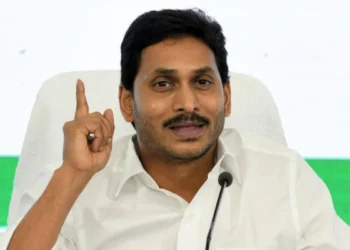












During his tenure as Chief Minister of Andhra Pradesh, YS Jagan Mohan Reddy adopted a cautious and farmer-centric approach to land acquisition and infrastructure development, consistently arguing that large-scale land pooling should not be pursued without clear necessity and safeguards. His administration maintained that development must not come at the cost of farmers’ livelihoods, land security, or long-term economic stability.
At a time when proposals were being advanced that required the pooling of nearly 15,000 acres of agricultural land, Jagan Mohan Reddy publicly stated that such an extent was neither essential nor justified. The YSR Congress Party (YSRCP) strongly opposed indiscriminate land pooling models, warning that they could expose farmers to prolonged uncertainty, delayed returns, and legal complications—concerns that later gained prominence in the context of the Amaravati capital region.
Opposition to Large-Scale Land Pooling
One of the central pillars of Jagan Mohan Reddy’s land policy was his firm resistance to compulsory or excessive land pooling. He argued that farmers should not be pushed into development frameworks where outcomes were uncertain and timelines unclear. The YSRCP leadership maintained that agricultural land was not merely an asset but a source of livelihood, identity, and intergenerational security for rural families.
Drawing lessons from earlier land acquisition experiences, the administration cautioned that farmers could face significant difficulties if promised infrastructure, compensation, or development benefits failed to materialise in a time-bound manner. This position stood in sharp contrast to models that relied heavily on farmer-owned land for large projects, often without adequate risk-sharing mechanisms.
YSRCP leaders repeatedly stated that development should first explore government-owned land before turning to private agricultural holdings. This stance resonated strongly among farming communities, particularly those closely observing the challenges faced by Amaravati farmers.

Use of Government Land as an Alternative Model
In line with this philosophy, the Jagan Mohan Reddy-led government identified approximately 2,200 acres of government-owned land for the proposed project. Importantly, the administration ensured that all statutory, environmental, and administrative approvals were obtained before initiating the project in 2023.
Officials emphasised that relying on government land reduced displacement risks, eliminated uncertainty for farmers, and ensured smoother implementation. By securing permissions in advance, the government sought to prevent legal hurdles and delays that often plague large infrastructure projects.
This approach was positioned as a balanced development model—one that enabled infrastructure creation while safeguarding rural interests. Supporters argue that this decision demonstrated administrative prudence and sensitivity toward agrarian concerns.
Amaravati Experience and Farmer Sentiment
The Amaravati capital region became a key reference point in debates surrounding land pooling in Andhra Pradesh. Many farmers who had pooled their land reported prolonged delays, uncertainty over returns, and challenges related to land value realisation. These experiences reinforced the YSRCP’s argument that land pooling carries long-term risks when governance continuity and financial clarity are absent.
YSRCP leaders consistently stated that had similar land pooling been implemented elsewhere, farmers could have faced comparable hardships. By opposing such models, they claimed, the party helped protect thousands of farmers from entering uncertain arrangements.
Farmer organisations and rural stakeholders acknowledged that the resistance to land pooling reflected a precautionary approach, particularly at a time when agricultural incomes were already under stress due to rising input costs and climate variability.
Political Opposition and Policy Debate
The land policy adopted during Jagan Mohan Reddy’s tenure was not without political contention. Opposition parties criticised the government’s approach, arguing that large-scale projects required expansive land parcels. However, the YSRCP countered that development should be sustainable, lawful, and socially equitable, rather than driven by urgency alone.
Jagan Mohan Reddy repeatedly stated that development decisions should not be imposed but arrived at through consultation, transparency, and respect for farmer consent. This philosophy aligned with the broader YSRCP governance narrative, which emphasised direct benefit delivery, decentralisation, and welfare-oriented administration.
Long-Term Implications for Land Governance
Policy analysts note that the land strategy adopted during this period could influence future governance models in Andhra Pradesh. By prioritising government land and limiting farmer displacement, the approach introduced an alternative framework for balancing infrastructure growth with social stability.
The emphasis on securing approvals before project initiation also highlighted the importance of institutional compliance and planning discipline, reducing the risk of stalled projects and legal disputes.
For farmers, the policy reaffirmed the principle that agricultural land should not be the default resource for development, especially when viable alternatives exist.
Conclusion: A Cautious and Farmer-First Policy Legacy
YS Jagan Mohan Reddy’s land policy during his tenure reflected a governance approach that placed farmer welfare and risk mitigation at the centre of development planning. By opposing the acquisition of 15,000 acres through land pooling and opting instead for government land with full approvals, the administration sought to prevent long-term hardships for cultivators.
While political debates around land use continue, the policy stance adopted during this period remains significant for its emphasis on consent, caution, and sustainability. For many farmers, the decisions taken then are viewed as a protective measure that preserved land ownership and economic security in an uncertain development landscape.