


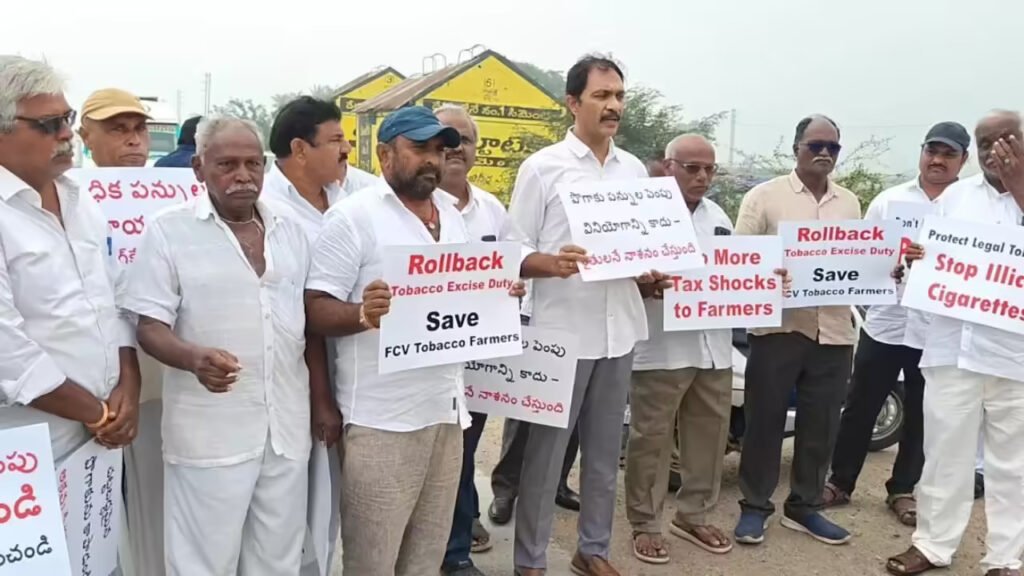
Thousands of tobacco farmers across Andhra Pradesh and Karnataka have launched widespread protests against the Centre’s recent decision to sharply increase taxes on tobacco products. Demonstrations, including rasta rokos, dharnas, and rallies, were reported from multiple districts, reflecting deep unrest among farming communities dependent on tobacco cultivation for their livelihoods. Farmer groups argue that the move threatens not only their income security but also the stability of the tobacco supply chain.
The protests come in response to new duty rules notified by the Union government on chewing tobacco, jarda scented tobacco, and gutkha packing machines. Farmers allege that the tax hike contradicts earlier assurances of a revenue-neutral transition from the compensation cess regime to an alternative taxation framework.
FAIFA Flags Economic Risks and Market Disruption
The Federation of All India Farmer Associations (FAIFA) has reacted strongly, warning that steep tax increases will force manufacturers to raise product prices, leading to reduced sales. This, in turn, could lower procurement demand for raw tobacco, leaving farmers with unsold produce and triggering a glut in the market.
According to FAIFA, the ripple effects of the tax hike extend beyond revenue considerations. Reduced demand could destabilise the agricultural economy in tobacco-growing regions, particularly in Andhra Pradesh and Karnataka, where Flue-Cured Virginia (FCV) tobacco forms a major component of rural income.
Concerns Over Discriminatory Taxation
Farmer associations have also raised concerns about what they describe as a discriminatory taxation regime. They point out that FCV tobacco growers already face disproportionately high tax rates on cigarettes, which are reportedly over 50 times higher per kilogram compared to bidis and over 30 times higher than chewing tobacco.
This disparity, farmers argue, places an unfair burden on specific crop growers while allowing other tobacco segments to remain relatively unaffected. They contend that such imbalances undermine equity in agricultural policy and place FCV farmers at a structural disadvantage.
Risk of Smuggling and Illicit Trade
Another major concern highlighted during the protests is the potential rise in smuggling and illicit trade. Farmer bodies warn that excessive taxation could make legal tobacco products uncompetitive, encouraging illegal manufacturing and cross-border smuggling. This would not only reduce legitimate sales but also weaken regulatory oversight and tax collection.
Experts note that similar trends have been observed in the past, where sharp tax hikes inadvertently fuelled informal markets, hurting both farmers and lawful manufacturers.
Demand for Revenue-Neutral and Balanced Policy
Farmers are not opposing regulation or public health objectives but are demanding a balanced and revenue-neutral approach. They have urged the Centre to reissue tax rates that discourage consumption without destabilising agricultural livelihoods. FAIFA and other associations have called for structured consultations with stakeholders before implementing major fiscal changes.
The protesting farmers insist that sustainable policy must account for farmer welfare, employment, and rural economic stability alongside taxation and health considerations.
Call for Policy Review and Dialogue
As protests continue, pressure is mounting on the Centre to review its decision and open channels for dialogue with farmer representatives. With tobacco farming supporting lakhs of families across southern India, stakeholders warn that prolonged uncertainty could have long-term socio-economic consequences.
The situation underscores the need for inclusive policymaking that balances fiscal goals, public health priorities, and the livelihoods of those at the base of the agricultural economy.