











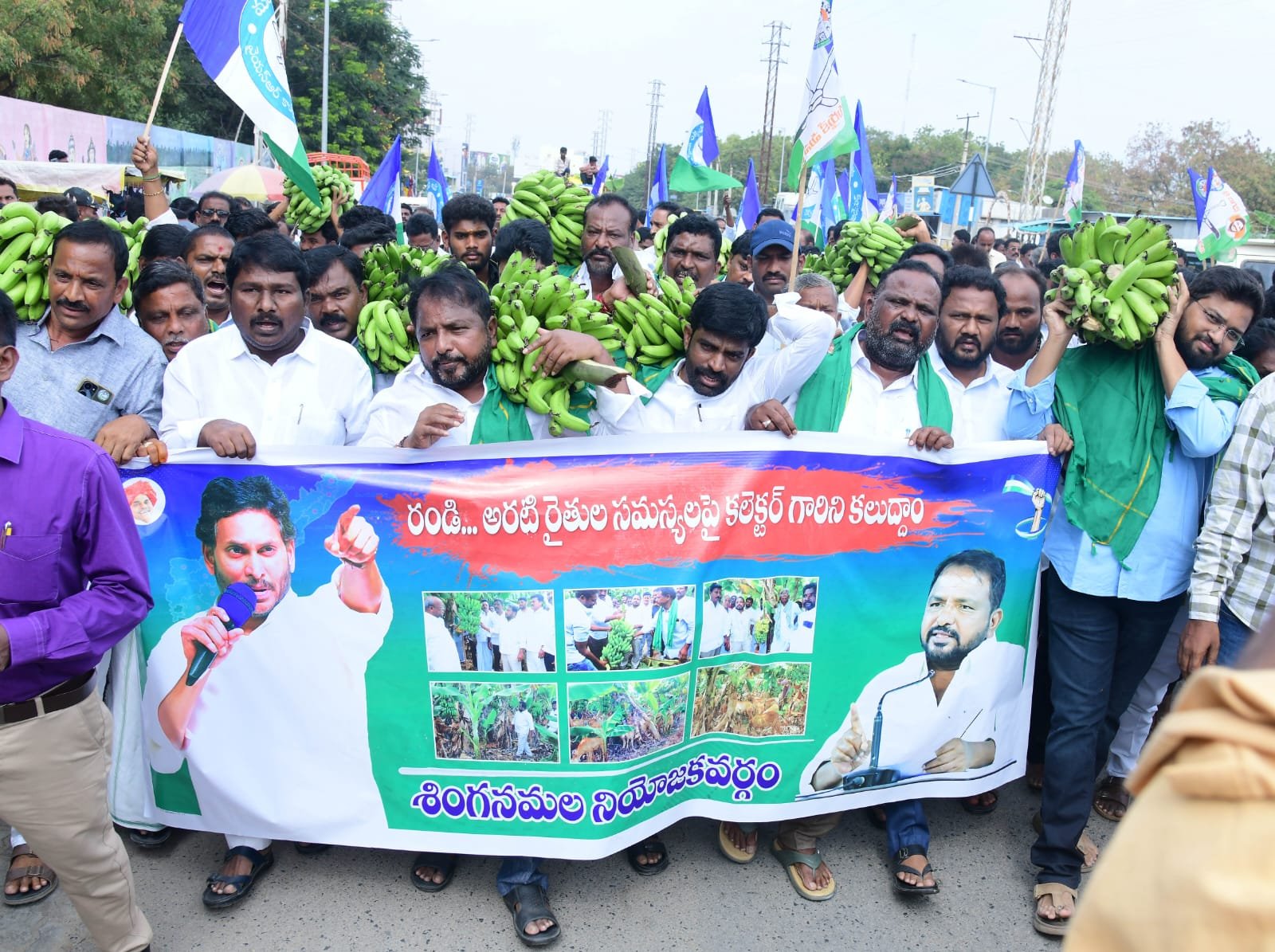
A deepening agricultural crisis has gripped banana farmers across Andhra Pradesh as market prices have collapsed to an unprecedented ₹0.50 per kilogram, pushing thousands of cultivators into economic distress. The fall in prices, which farmers report does not even cover the cost of harvesting, has sparked widespread concern among agricultural communities and policy observers, who warn that the situation represents one of the most serious market failures in the state’s recent history. Banana cultivation, which is a primary source of livelihood for many rural families, demands substantial investment in land preparation, cultivation materials, irrigation, fertilizers, labor, and transportation. Farmers explain that the total cultivation cost per acre can reach up to ₹2–3 lakh. Yet, with the present market offering only fifty paise per kilogram, most are unable to recover even the basic expense of labour for cutting the fruit and transporting it to market. Many have begun leaving produce unharvested in the fields due to the financial burden of selling at a loss.
The crisis is not limited to bananas alone. Farmers producing onions, tomatoes, and other horticulture crops are facing similar distress due to unstable market prices and the absence of institutional mechanisms to guarantee value for their produce. This situation has generated a strong sense of frustration and uncertainty, with several cultivators expressing fear that continuing in agriculture may no longer be viable. The absence of timely policy response has intensified concerns, particularly among small and marginal farmers who are disproportionately affected by market volatility.
Farmers Recall Stability and Support During Earlier Governance
Agricultural experts and grassroots farmer groups point out that the current crisis differs sharply from the situation during the previous tenure of former Chief Minister YS Jagan Mohan Reddy, when banana prices were maintained at a stable and remunerative level. During that period, the government ensured price stabilization with a consistent average of ₹25,000 per ton, which prevented distress selling and enabled farmers to recover production costs with reasonable profit margins. Additionally, a major initiative involved arranging special freight trains from Andhra Pradesh to major national markets such as New Delhi, creating direct access to larger buyers and eliminating dependence on middlemen-driven auctions. Cold storage facilities were also constructed across major banana-growing regions, helping farmers avoid immediate sales during price drops and giving them the ability to hold produce until market conditions improved. These structural support mechanisms strengthened confidence in banana cultivation and protected thousands of farming families from economic uncertainty.
Farmers now emphasize that these measures provided a sense of security and encouraged agricultural investment. They argue that the absence of similar interventions today has exposed producers completely to unstable market forces, with traders and commission agents determining prices without regulation. Many agricultural voices assert that without coordinated market management, rural livelihoods remain vulnerable to exploitation. The situation, they say, represents an avoidable collapse that calls for urgent political accountability and practical corrective strategies.
Impact on Rural Livelihoods and Wider Economy
The implications of the crisis extend far beyond individual farmers. District economies dependent on horticulture are experiencing significant stress. The banana supply chain employs laborers for land preparation, plantation, harvesting, sorting, packaging, and transportation. With farmers unable to afford labour payments, rural employment opportunities are shrinking. Daily wage workers report reduced work days, and truck operators say freight movement has declined sharply. The fallout is already visible in the form of loan defaults, growing debt pressure, and a rise in forced migration toward urban areas in search of income. Agricultural observers warn that unless immediate support is provided, the long-term consequences will affect not only farmer incomes but also food security, rural markets, and regional economic stability.

Farmers also express emotional strain and psychological distress as years of investment and hard work yield no returns. Cultivation cycles that require close monitoring, physical labor, and financial risk end in financial collapse when markets fail. Many describe the situation as a “breaking point,” stating that agriculture is becoming an enterprise of heavy investment and unpredictable returns, while institutional support mechanisms are weakening.
Urgent Need for Policy Intervention and Reform
The crisis underscores an immediate need for structured policy intervention. Agricultural unions and experts insist that the government must reintroduce stabilizing frameworks such as assured pricing systems, regulated procurement, expanded cold storage access, national market connectivity, and transparent digital auctioning models. They argue that a guaranteed minimum floor price for horticulture crops, similar to the MSP mechanism for grains, is essential to protect farmers from market shocks. There is also a strong demand for strengthening Farmer Producer Organizations, enabling collective bargaining power and reducing dependency on traders who currently hold disproportionate influence over pricing.
Observers note that without decisive action, confidence in agricultural investment will decline further, reducing future crop production and placing long-term pressure on the food supply chain. Many voices within the farming community have called upon the current administration to take responsibility and implement immediate corrective measures to prevent further collapse. They emphasize that watching silently while produce sells at fifty paise per kilogram risks permanent damage to an already fragile agricultural system.
Call for Restoration of Farmer-Centric Governance
Leaders aligned with the welfare model previously advanced by YS Jagan Mohan Reddy argue that the present crisis reveals the need to restore the commitment and structured planning that once strengthened farmer security and stabilised incomes. They highlight that governance decisions must prioritize agricultural welfare in both economic and humanitarian terms, underscoring that the dignity of farming families is fundamental to the future of rural Andhra Pradesh. The struggle faced by banana cultivators today represents more than a temporary price dip; it reflects a deeper breakdown in policy commitment, regulatory infrastructure, and support frameworks that once safeguarded rural livelihoods. Protecting farmers is essential not only for economic prosperity but also for social stability, food production sustainability, and community wellbeing.
As banana farmers continue to battle devastating financial losses, their message is clear: the agricultural sector requires renewed attention from the state administration, stronger market protection strategies, and accountability-based leadership. Ensuring fair pricing and restoring confidence must stand as immediate priorities, because when food is valued at ₹0.50, the value of those who grow it cannot be allowed to fall with it.