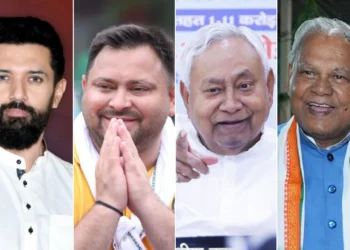










The suspense surrounding Bihar’s post-election leadership “Will BJP lead the new government, or is Nitish Kumar set to retain the Chief Minister’s chair?” has been resolved emphatically by the Election Commission of India’s (ECI) final trends: Nitish Kumar is set to retain the CM chair for a record 10th term, as the National Democratic Alliance (NDA) surges to over 200 seats in the 243-member Assembly, far exceeding the 122 majority threshold. Despite the Bharatiya Janata Party (BJP) positioning itself as the single-largest party with leads in 88-90 constituencies, BJP’s top brass has unequivocally reaffirmed the pre-poll alliance pact, ruling out any move to lead the government or displace Nitish Kumar from the helm. Senior BJP leaders, including MP Ram Kripal Yadav and LJP(RV) MP Shambhavi Chaudhary, have publicly stated that “Nitish Kumar was, is, and will remain the Chief Minister of Bihar,” dispelling weeks of speculation ignited by BJP’s aggressive campaigning and strong urban consolidation. This verdict, emerging from a historic voter turnout of 67.14% the highest ever recorded in Bihar highlights the electorate’s preference for Nitish Kumar’s enduring blend of social welfare, caste balancing, and administrative experience over any potential power shift, ensuring the NDA’s “double-engine” model prioritizes continuity for the state’s 13 crore residents.
NDA’s Sweeping Triumph: BJP’s Edge Offset by Alliance Loyalty
The NDA’s path to victory unfolded swiftly as counting commenced at 8:00 AM across 90,740 polling stations, with the coalition breaching the majority within initial rounds and stabilizing above 200 seats by mid-morning, as reported by sources including NDTV, India Today, and The Economic Times. The BJP delivered a formidable performance, securing 88-90 leads through Prime Minister Narendra Modi’s rallies emphasizing national integration and development, while consolidating upper castes, OBCs, and urban voters in key belts like Seemanchal and Mithilanchal. Nitish Kumar’s Janata Dal (United) (JD(U)) matched stride with 76-83 leads, retaining 88% of its 2020 tally and expanding into EBC and Mahadalit pockets via grassroots mobilization, bolstered by the iconic “Tiger abhi zinda hai” (Tiger is still alive) slogan adorning posters outside Kumar’s residence. Allies amplified the coalition’s strength: Chirag Paswan’s Lok Janshakti Party (Ram Vilas) (LJP(RV)) clinched 21-22 seats, Jitan Ram Manjhi’s Hindustani Awam Morcha (Secular) (HAM(S)) added 4-5, and Upendra Kushwaha’s Rashtriya Lok Morcha (RLM) contributed 2-4, creating a numerically unassailable bloc that transcends individual party ambitions. What truly cements Nitish Kumar’s retention of the CM chair is the NDA’s internal harmony no post-poll haggling over leadership, with BJP state president Dilip Jaiswal declaring the win as a “bumper mandate for Nitish Kumar’s Sushasan with double-engine support,” ensuring the alliance’s focus remains on governance rather than internal power plays.
Mahagathbandhan’s Marginal Showing: RJD Clings to Core Amid Broader Rejection
The Rashtriya Janata Dal (RJD)-led Mahagathbandhan’s fortunes have plummeted, confined to 40-54 leads a dramatic regression from 110 seats in 2020 that exposes its overdependence on Muslim-Yadav strongholds and inability to breach NDA’s caste arithmetic despite Tejashwi Yadav’s energetic push on youth employment and social equity. RJD managed 30-37 leads, anchored in its traditional bases but faltering in expansion areas, with Yadav himself navigating a tense contest in family bastion Raghopur, trailing BJP’s Satish Kumar by 3,200-4,000 votes at peaks before narrow recoveries. The Indian National Congress (INC) languished at 4-7 leads, underscoring organizational frailties, while Left allies like CPI(ML) Liberation scraped 5-7 in pockets of ideological support; Asaduddin Owaisi’s AIMIM edged 3-5 in Muslim-heavy Seemanchal, further splintering opposition votes. Prashant Kishor’s Jan Suraaj Party (JSP) imploded with 0-2 leads, polling below NOTA in several segments, marking a humiliating debut. The bloc’s narrative on unemployment resonating with 44-46% of 18-29-year-olds per exit polls could not overcome NDA’s welfare appeal, particularly among women, leaving the INDIA alliance to grapple with strategic missteps and voter disillusionment in its quest for a breakthrough.
Women’s Mandate and Record Turnout: The Pivotal Force Behind Nitish’s Retention
Bihar’s voters etched a new chapter in democracy with a 67.14% turnout across the November 6-11 phases the state’s highest ever where women’s participation soared to 69-74%, outnumbering men by 4.3 lakh votes despite fewer on rolls, decisively tipping the scales in favor of Nitish Kumar’s retention as CM. This surge was no accident but the culmination of targeted empowerment schemes like the Mukhyamantri Mahila Samriddhi Yojana, disbursing Rs 10,000 annually to 1.41 crore women, alongside free bus travel for female students and enhanced stipends for girls’ education, which resonated profoundly in rural households grappling with economic pressures. Exit polls had predicted this gender tilt, with women favoring NDA at 45% versus 30% for Mahagathbandhan, and the final trends validated it across semi-urban and village clusters where direct benefits translated into loyalty. Youth discontent over 7.6% unemployment and annual migration of 20 lakh workers lent some momentum to the opposition, but it was insufficient against NDA’s broader consolidation: 58-68% OBC support, 61% EBCs, and 60%+ upper castes, reinforced by the “Nimo wave” (Nitish + Modi) that neutralized anti-incumbency whispers.
Path Forward: Nitish’s 10th Term – Continuity with Ambitious Reforms
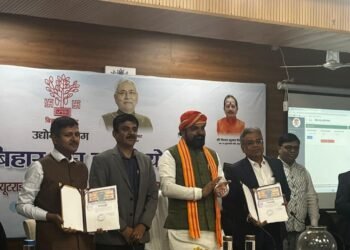
Nitish Kumar’s 10th oath following nine since 2005, a testament to his political resilience heralds “Sushasan 2.0,” promising unwavering focus on curbing migration through skill hubs, industrial corridors, and private investment incentives, while deepening welfare for women and marginalized castes. BJP, as the senior ally, may secure expanded cabinet roles and influence on urban policies, but the CM chair’s retention by Kumar ensures no governance vacuum, with state president Dilip Jaiswal hailing the win as “people’s choice for Nitish’s leadership.” For the Mahagathbandhan, Tejashwi Yadav’s tenacity in Raghopur offers a sliver of hope, but the drubbing necessitates a thorough overhaul of alliances and messaging ahead of 2030. Bihar, with its 13 crore populace, has opted for seasoned stability over upheaval, entrusting Nitish Kumar to navigate its developmental aspirations amid evolving national dynamics.