









The counting of votes for the November 2025 by-elections to eight Assembly constituencies spanning seven states has unveiled a tapestry of electoral outcomes that balance national ambitions with regional entrenchment, as Bharatiya Janata Party (BJP) and Indian National Congress (INC) each notched two victories and leads, while local powerhouses like Peoples Democratic Party (PDP), Mizo National Front (MNF), Aam Aadmi Party (AAP), and Jharkhand Mukti Morcha (JMM) defended their turfs with varying margins amid turnouts fluctuating between 50% in urban Telangana to 70% in rural Jharkhand, reflecting a electorate attuned to hyper-local concerns such as development, caste dynamics, and governance delivery in these single-seat battlegrounds that often foreshadow larger political realignments. With the Election Commission of India (ECI) declaring results under tight security and real-time monitoring, these by-polls—triggered by resignations, deaths, or disqualifications—serve as critical litmus tests for party machineries, coalition stabilities, and voter moods in the lead-up to more expansive contests, ultimately reinforcing the resilience of India’s federal democracy where diverse voices converge to demand accountable leadership at every level.
National Parties’ Balanced Gains: BJP and Congress Claim Key Territories
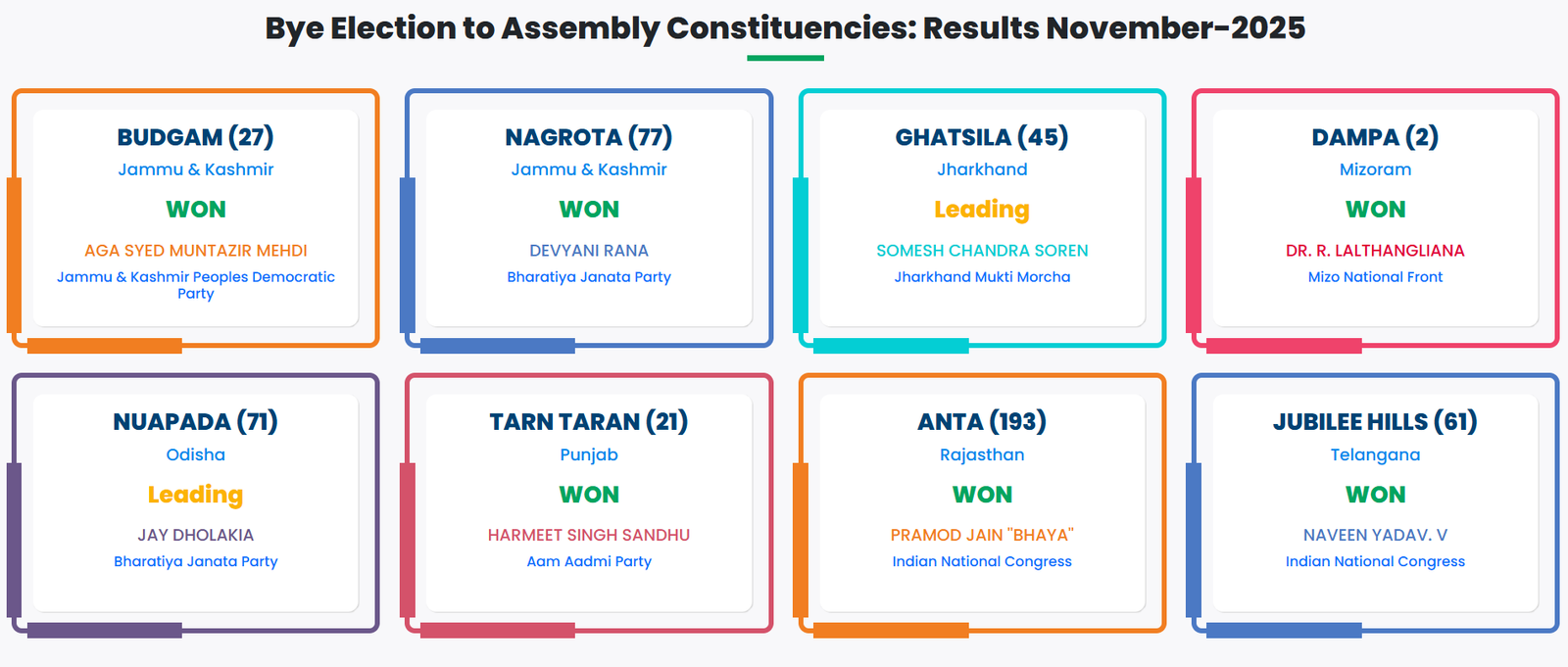
The Bharatiya Janata Party asserted its expanding footprint with a resounding win in Jammu & Kashmir’s Nagrota constituency, where Devyani Rana of BJP secured a substantial victory by a margin of 24,647 votes over challengers from the National Conference and PDP, capitalizing on the party’s post-delimitation organizational surge in the Jammu region and voter sentiment favoring integration and development post-Article 370 abrogation, a result that not only bolsters BJP’s narrative of normalcy in the Union Territory but also enhances its bargaining power within the NDA framework for future statehood discussions. Complementing this, BJP candidate Jay Dholakia established a commanding lead of 82,911 votes in Odisha’s tribal-heavy Nuapada seat against the ruling Biju Janata Dal (BJD) and Congress, highlighting the saffron party’s penetration into Adivasi belts through targeted promises on forest rights, infrastructure, and anti-corruption drives that resonate in a state long dominated by regional satraps, potentially eroding BJD’s unchallenged reign and setting the stage for a bipolar 2029 Assembly battle.
In a parallel resurgence, the Indian National Congress registered two pivotal wins that signal tactical recoveries in western and southern India, first in Rajasthan’s Anta where party stalwart Pramod Jain “Bhaya” amassed 69,571 votes to defeat BJP’s Morpal Suman and Independent Naresh Meena by a margin of 15,612 votes, a triumph rooted in Congress’s robust grassroots mobilization on agrarian distress, youth employment, and local welfare schemes that countered BJP’s national Hindutva pitch in this eastern Rajasthan pocket. Congress’s second success came in Telangana’s upscale Jubilee Hills constituency in Hyderabad, where Naveen Yadav.V emerged victorious against the Bharat Rashtra Samithi (BRS) incumbent and BJP contender, leveraging urban discontent over water scarcity, traffic woes, and governance lapses to extend the party’s influence in a state where it has been steadily rebuilding since the 2023 polls, thereby challenging the regional duopoly and positioning Congress as a credible urban alternative in the Deccan plateau.
Regional Parties’ Tenacity: PDP, MNF, AAP, and JMM Fortify Local Bastions
Regional parties demonstrated unyielding local connect by clinching or leading in their entrenched domains, beginning with the Jammu & Kashmir Peoples Democratic Party (PDP)’s emphatic win in the Kashmir valley’s Budgam seat, where Aga Syed Muntazir Mehdi garnered 21,576 votes to prevail over the National Conference and an independent by 4,478 votes, while relegating BJP’s Mohsin Mosvi to a humiliating sixth place with a mere 2,619 votes, a outcome that revives PDP’s Kashmiri identity politics and underscores the challenges national parties face in penetrating valley sentiments amid ongoing security and autonomy debates. In Mizoram’s Dampa constituency, the Mizo National Front (MNF) narrowly retained power with Dr. R Lalthangliana’s victory by a razor-thin margin of 562 votes against Zoram People’s Movement (ZPM) and Congress rivals, preserving the party’s northeastern tribal legacy through appeals to cultural preservation and statehood rights, a fragile hold that highlights the delicate ethnic balances in the hill state.
Punjab’s ruling Aam Aadmi Party (AAP) solidified its governance credentials by defending the Tarn Taran Assembly seat with Harmeet Singh Sandhu’s win over Akali Dal and Congress challengers, banking on Chief Minister Bhagwant Mann’s deliverables like free electricity, healthcare reforms, and anti-drug initiatives that resonate in the border district plagued by narco-terrorism, thereby quelling murmurs of anti-incumbency just a year into AAP’s maiden term. Meanwhile, in Jharkhand’s Ghatsila, Jharkhand Mukti Morcha (JMM)’s Somesh Chandra Soren is comfortably leading against BJP and AJSU opponents, reinforcing the Hemant Soren-led coalition’s grip on Adivasi votes through promises of land rights and forest produce benefits, a momentum that could prove crucial in the full 2029 Assembly elections amid the state’s mineral-rich tribal heartlands.

Voter Insights and Broader Ramifications: Turnout Trends and Electoral Signals
These by-election results, with average voter participation hovering around 60% and peaking in Jharkhand’s tribal terrains, offer a mosaic of electoral signals where local incumbency advantages and welfare deliverables often eclipse national narratives, as seen in AAP’s Punjab hold and MNF’s Mizoram retention, while Congress’s Rajasthan and Telangana gains suggest a revival in opposition spaces through hyper-local campaigns. For BJP, the J&K and Odisha successes expand its saffron canvas, but the Budgam drubbing reminds of regional barriers; nationally, these contests preview coalition imperatives for 2029, emphasizing the need for adaptive strategies that harmonize central agendas with state-specific aspirations, ultimately fostering a more responsive governance model attuned to India’s federal diversity.