










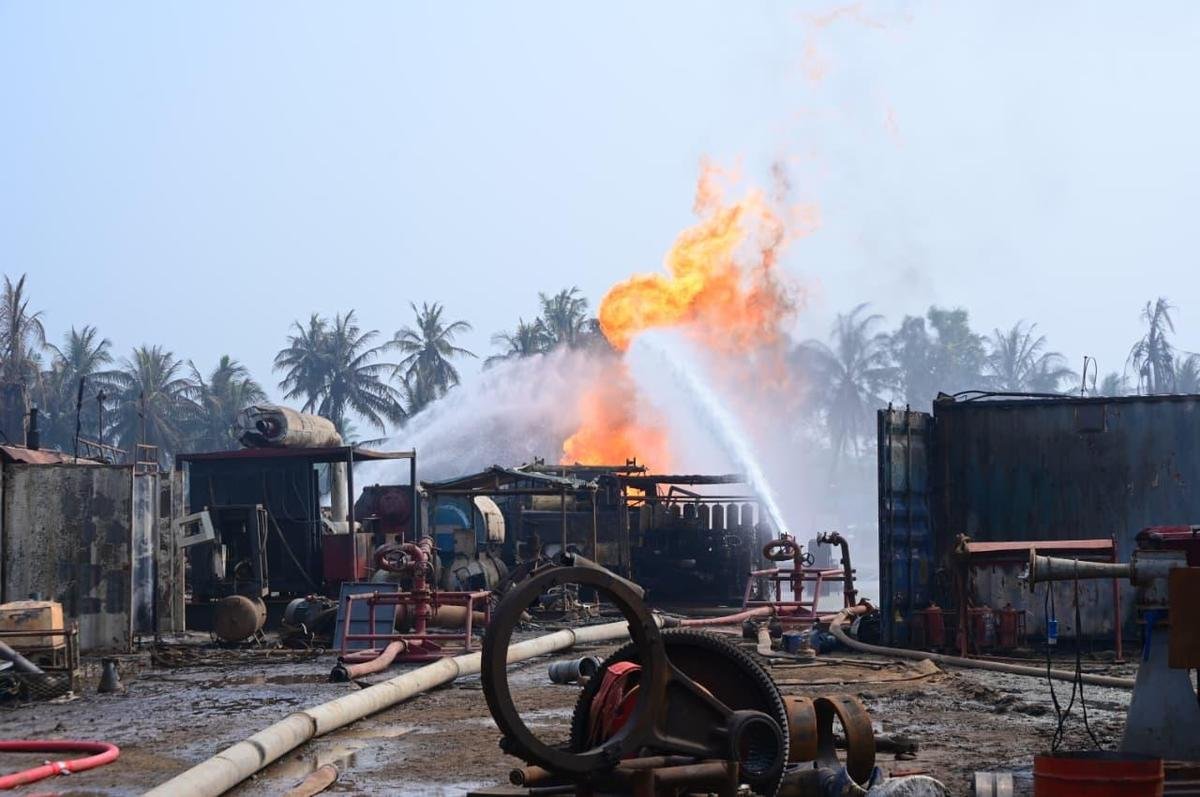
After nearly three days of sustained firefighting and blowout control operations, authorities have declared it safe for residents evacuated from villages near the ONGC Mori-5 gas well in Andhra Pradesh’s Dr. B.R. Ambedkar Konaseema district to return to their homes. The massive blaze, which erupted during repair operations at the wellsite, has now been substantially contained, with officials stating that the likelihood of further escalation is remote.
The gas well fire broke out on January 5 at the Mori-5 well, part of ONGC’s Rajahmundry Asset, during workover operations being carried out under a Production Enhancement Contract by M/s Deep Industries. Flames reportedly rose nearly 20 metres into the air, prompting immediate emergency measures and large-scale evacuation as a precautionary step.
Evacuation and Emergency Response
In the immediate aftermath of the incident, over 500 residents from Irusumanda and Mori villages were evacuated as a safety measure. Relief camps were set up to accommodate affected families, while district authorities coordinated closely with ONGC and emergency response teams to manage the evolving situation.
Officials said the decision to evacuate was taken to eliminate any risk to human life, given the intensity of the fire and the uncertainty surrounding the stability of the well during the initial stages.
Blowout Control and Firefighting Operations
ONGC’s Crisis Management Team (CMT), supported by technical experts from Delhi and Mumbai, worked round the clock along with PEC contractor Deep Industries to bring the situation under control. According to officials, the intensity of the blaze, ambient heat levels, and noise have dropped sharply over the last 24 hours.

A new approach road was constructed from the rear side of the wellsite to enable heavy logistics and machinery to reach the “ground zero” area. Engineers also established a continuous water blanket system, a critical cooling mechanism that allowed personnel to operate in close proximity to the wellhead.
Debris Removal and Well Capping Preparations
Systematic removal of damaged rig components and debris is currently underway to create a clear line of sight for the final stage of operations—capping the wellhead. Officials indicated that this phase is crucial for completely neutralizing the incident and ensuring long-term safety at the site.
With the fire nearly 90 percent contained, authorities have ruled out the possibility of a secondary explosion, allowing evacuation orders to be lifted.
Residents Advised to Return Home
Based on expert assessments and continuous monitoring, the Konaseema district administration has issued an advisory permitting residents of evacuated villages to return home. Relief camps, which had been operational since Monday, are now expected to be wound down gradually.
“Steady progress has been made, and in view of the remote likelihood of any escalation, residents are advised to resume their daily routines,” a senior district official said.
Environmental Monitoring and Compensation
ONGC has reiterated that community safety and environmental protection remain its highest priorities. Continuous monitoring of air quality and nearby water bodies is being conducted within a 600-metre radius of the wellsite.
While preliminary reports indicate crop damage to paddy fields and coconut plantations in the immediate vicinity, officials have assured that detailed assessments will be carried out once the well is fully capped. Compensation measures will be initiated based on the findings of these assessments.
Focus on Recovery and Accountability
The incident has brought renewed focus on safety protocols during workover operations at oil and gas installations. Authorities have indicated that a detailed review of procedures and compliance mechanisms will follow after the incident is fully resolved.
As normalcy gradually returns to the affected villages, officials emphasized the importance of preparedness, coordination, and transparent communication in managing industrial emergencies.