


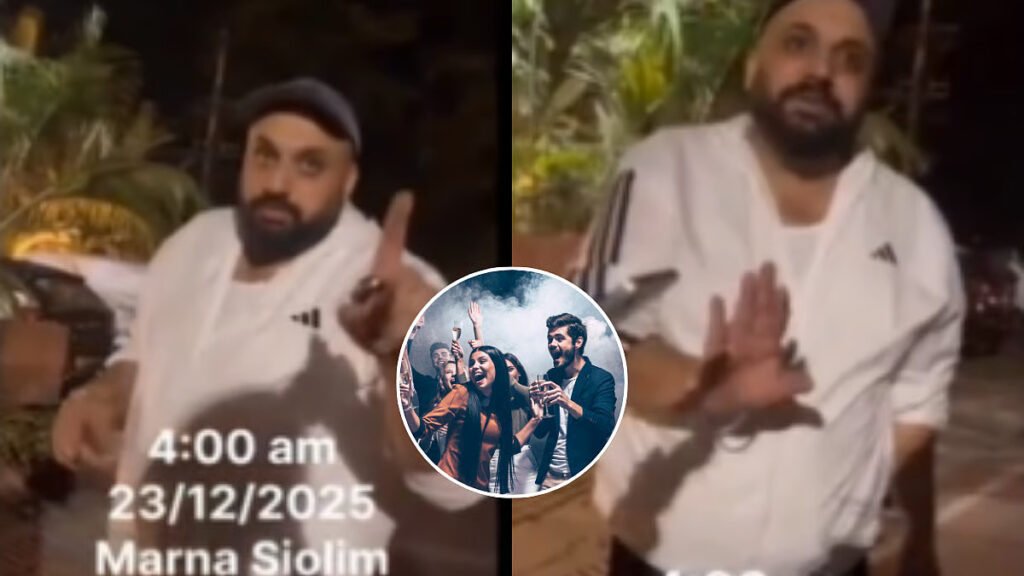
A video from Goa capturing a heated confrontation between a local resident and a group of tourists over loud music during late-night hours has gone viral on social media, triggering widespread discussion on tourism behaviour, residential peace, and law enforcement responsiveness. The incident is reported to have taken place around 4 am on December 23 in the Marna–Siolim residential area, a locality primarily inhabited by local families.
The footage has since circulated widely on platforms such as Instagram, prompting strong reactions from both residents and tourism stakeholders.
Incident Shared Online With Allegations of Disturbance
The video was shared on Instagram by user Aaron Fernandes, who alleged that a group of tourists had been playing loud music in a residential zone between midnight and 4 am. According to the claims made in the caption accompanying the video, the tourists were also accused of driving a rented jeep into private property, damaging household items, and threatening residents and staff members in the area.
The post further alleged that despite repeated complaints to the authorities, police personnel reportedly arrived nearly two hours after the first call was made.
Footage Shows Confrontation in Early Morning Hours
The clip shows a local resident confronting a group of tourists over the disturbance, questioning their behaviour and objecting to loud music during prohibited hours. The exchange appears tense, reflecting growing frustration among residents over repeated late-night disruptions in residential neighbourhoods.
Text overlaid on the video contains strong language expressing anger over the perceived behaviour of tourists. Observers have noted that while emotions in the clip reflect genuine distress, such language has also raised concerns over generalisation and the tone of public discourse.
Debate Over Responsible Tourism and Civic Behaviour
The viral nature of the video has reignited debate over responsible tourism in Goa, particularly in villages and residential zones not designated for nightlife or party activity. Residents have increasingly voiced concerns about noise pollution, trespassing, and a lack of respect for local communities, especially during late-night hours.
Tourism experts and civic groups have stressed that while tourism remains vital to Goa’s economy, adherence to local laws, cultural sensitivity, and respect for residential spaces are essential to maintaining social harmony.
Questions Raised on Enforcement and Response Time
The incident has also drawn attention to enforcement challenges, with allegations of delayed police response forming a key part of the discussion online. Citizens have called for clearer protocols, quicker response mechanisms, and stricter action against violations of noise regulations, particularly during night hours.
Authorities have repeatedly stated that noise restrictions are in place and that action is taken against violations, though public perception often hinges on visible and timely enforcement.
Balancing Tourism Growth With Residential Rights
As Goa continues to attract large numbers of domestic and international tourists, the incident underscores the need to balance economic activity with the rights of residents to safety, privacy, and peace. Policy observers argue that clearer zoning enforcement, stronger coordination between tourism stakeholders and law enforcement, and awareness campaigns for visitors could help prevent such flashpoints.
The viral video, while highlighting an isolated incident, reflects a broader conversation on governance, civic responsibility, and coexistence in high-tourism regions.
Call for Accountability and Sensitivity
The Marna–Siolim incident has become a focal point for discussions around public order, tourism management, and social responsibility in Goa. While investigations and clarifications may follow, the episode has reinforced calls for accountability, mutual respect, and stronger institutional response to protect both residents and the tourism ecosystem.