


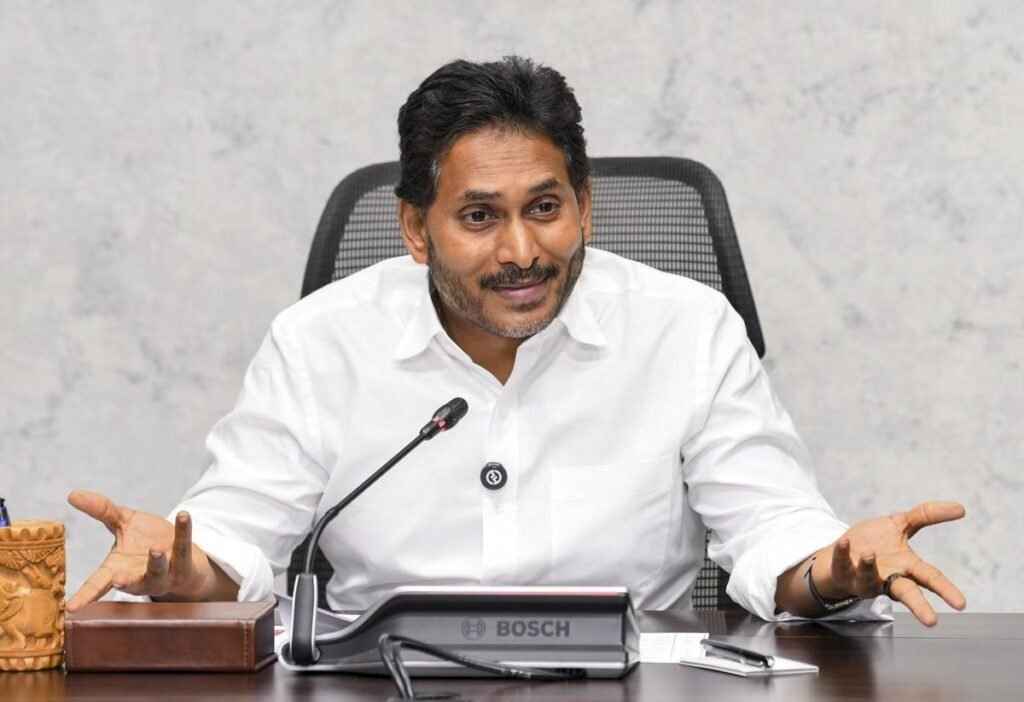
The debate over healthcare governance in Andhra Pradesh has intensified as Jagan Mohan Reddy publicly questioned the privatisation of government medical colleges undertaken during Chandrababu Naidu’s administration. The central issue raised by Jagan focuses on the financial implications of that policy—specifically, the continued use of taxpayer money to pay the salaries of staff working in colleges that have already been shifted to private control.
This development has brought renewed attention to the state’s decision-making process in the health sector, raising concerns about transparency, accountability, and the long-term impact on medical education and public healthcare delivery.
Privatisation Under Naidu Government and Its Controversial Structure
During Chandrababu Naidu’s tenure, several government medical colleges were reportedly moved into private administration under the justification of improving efficiency and modernising infrastructure. However, Jagan has questioned the fundamental design of this model. His concern stems from the fact that, despite privatisation, the government continues to bear the financial responsibility of paying salaries—a practice he describes as both unusual and troubling.
In a typical privatisation framework, operational and financial responsibilities are transferred to the private entity. The alleged continuation of government-funded salaries contradicts these norms and has prompted Jagan to demand clarity from the administration responsible for the decision.
Implications for Public Healthcare and Medical Education
Government medical colleges form the backbone of Andhra Pradesh’s healthcare network. They train future doctors, support government hospitals, and serve communities across the state. When such institutions are privatised without transparent safeguards, several implications arise—reduced accessibility, commercialised education, and weakened public supervision.
Jagan Mohan Reddy has highlighted that the public health ecosystem cannot function effectively if foundational institutions face structural compromises. If salaries are funded by the government but operations are controlled privately, the result is an imbalance that strains public resources while offering limited accountability.
Demand for Transparency and Public Disclosure
A key component of Jagan’s statement revolves around transparency. He has questioned what financial studies, stakeholder consultations, or policy justifications were presented before privatising public institutions. The fact that public funds are allegedly still being utilised raises deeper concerns about whether due diligence was carried out.
Jagan argues that citizens have a right to know how taxpayer money is being deployed, particularly in sectors like healthcare where public welfare is directly impacted. He has urged the authorities responsible for the policy—namely Chandrababu Naidu’s government—to publicly explain the reasoning and financial logic behind such decisions.
Governance, Accountability, and the Need for Structural Reform
Jagan’s critique has brought governance standards to the forefront. He asserts that any reform involving public institutions must be transparent, efficient, and protective of public interest. The ongoing debate highlights the need for a comprehensive review of how public-private partnerships are structured in essential sectors.
He further stresses that safeguarding public funds and maintaining the integrity of medical education should be non-negotiable priorities. The controversy surrounding privatisation reinforces the urgency for stronger policy frameworks and stricter oversight to prevent misuse of public resources.
A Call for Responsible Administration
As the discussion continues, Jagan Mohan Reddy’s questions have amplified a broader demand for accountability from the administration that implemented the privatisation policy. Whether through public disclosure, independent audit, or legislative review, there is a growing call for the facts to be placed before the people.
The issue has emerged as a significant test of administrative transparency in Andhra Pradesh—a reminder that decisions involving core public institutions must always prioritise public welfare, financial integrity, and long-term planning.