


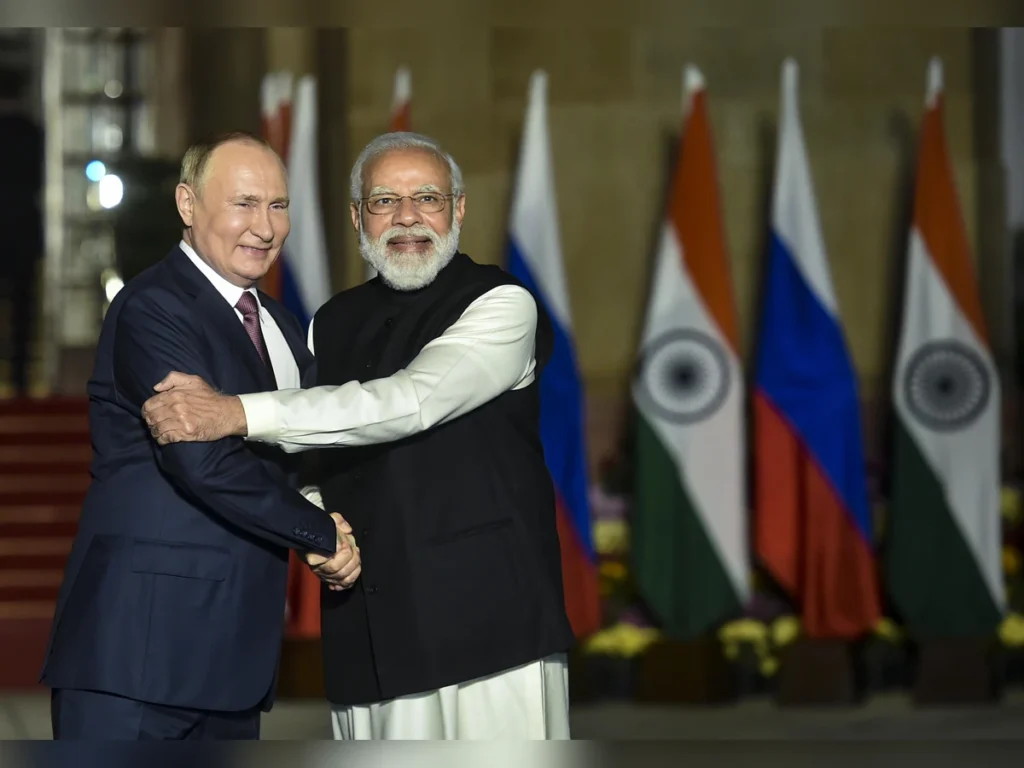
India is preparing to host Russian President Vladimir Putin on December 4–5 for the 23rd India–Russia Annual Summit, a meeting that arrives at a time of heightened geopolitical pressure and shifting global trade dynamics. Despite the recent imposition of punitive U.S. tariffs on Indian goods, New Delhi continues to pursue an independent foreign policy focused on strategic autonomy and long-term national interests. The high-level engagement is expected to deepen political dialogue, expand economic partnerships, and reinforce long-standing defense cooperation between the two nations.
Over the years, India and Russia have characterized their relationship as a “special and privileged strategic partnership,” one rooted in decades of cooperation across multiple sectors. Even as global alignments evolve, New Delhi continues to prioritize stable ties with Moscow, balancing external pressures while safeguarding its economic and security imperatives.
Trade Disparities Drive Push for Diversification
Trade expansion will be the central theme of the upcoming summit, particularly as both nations aim to address existing imbalances. In the fiscal year ending March 2025, India–Russia bilateral trade stood at $68.72 billion, heavily tilted in Russia’s favor. India’s exports amounted to $4.88 billion, while imports—largely crude oil—reached $63.84 billion. The two countries have set an ambitious target of increasing bilateral trade to $100 billion by 2030.
To move toward a more equitable framework, India is exploring new opportunities to increase exports of machinery, chemicals, agricultural products, and pharmaceuticals. Russia, on the other hand, is promoting cooperation in civilian nuclear energy and technological solutions, including the development of small modular reactors in India. Analysts expect the summit to lay the foundation for broader economic collaborations beyond the traditional energy sector.
Defense Cooperation Remains a Core Pillar
Defense cooperation is expected to feature prominently in the discussions, continuing a long history of military collaboration between the two countries. Reports suggest that India may explore acquisitions such as Russia’s next-generation Su-57 fighter jets and the S-500 missile defense system. However, concerns remain about Moscow’s production capabilities, especially amid ongoing supply-chain disruptions linked to semiconductor shortages.
Between 2020 and 2024, Russia remained India’s largest defense supplier, accounting for 36% of India’s total arms imports. Yet this share has been steadily declining as India broadens its procurement sources, engaging more with France, Israel, and the United States. The upcoming summit is anticipated to reassess ongoing commitments, future purchases, and the overall direction of the defense partnership.
U.S. Tariffs Complicate India’s Global Balancing Act
India’s diplomatic engagement with Russia occurs against the backdrop of mounting friction with Washington. The United States has imposed a cumulative 50% tariff—one of the highest on any country—on Indian goods as a penalty for New Delhi’s continued import of Russian oil. Washington alleges that India’s purchase and resale of Russian crude contributes indirectly to Moscow’s war efforts in Ukraine.
India, however, maintains that its energy imports are guided by the need to ensure affordability and energy security for its 1.4 billion citizens. To ease tensions, New Delhi has stepped up its energy purchases from the U.S., including a significant agreement by state-owned oil companies to import liquefied petroleum gas. Meanwhile, India has begun reducing Russian oil imports following U.S. sanctions on major Russian oil companies, Rosneft and Lukoil.
Looking Ahead: Strategic Autonomy at the Center of India’s Foreign Policy
The upcoming summit highlights India’s broader effort to strike a delicate balance among global powers. By engaging Russia despite U.S. pressure, New Delhi reaffirms its position as an independent actor with a clear strategic agenda. The outcomes of the summit—expected to include joint statements and multiple bilateral agreements—may shape the trajectory of India’s foreign, trade, and energy policies for years to come.
As geopolitical competition intensifies, India’s ability to maintain diversified partnerships while protecting its national interests remains crucial. The visit by President Putin underscores the resilience of India–Russia relations and reflects New Delhi’s commitment to navigating global challenges through diplomacy, strategic planning, and economic engagement.