


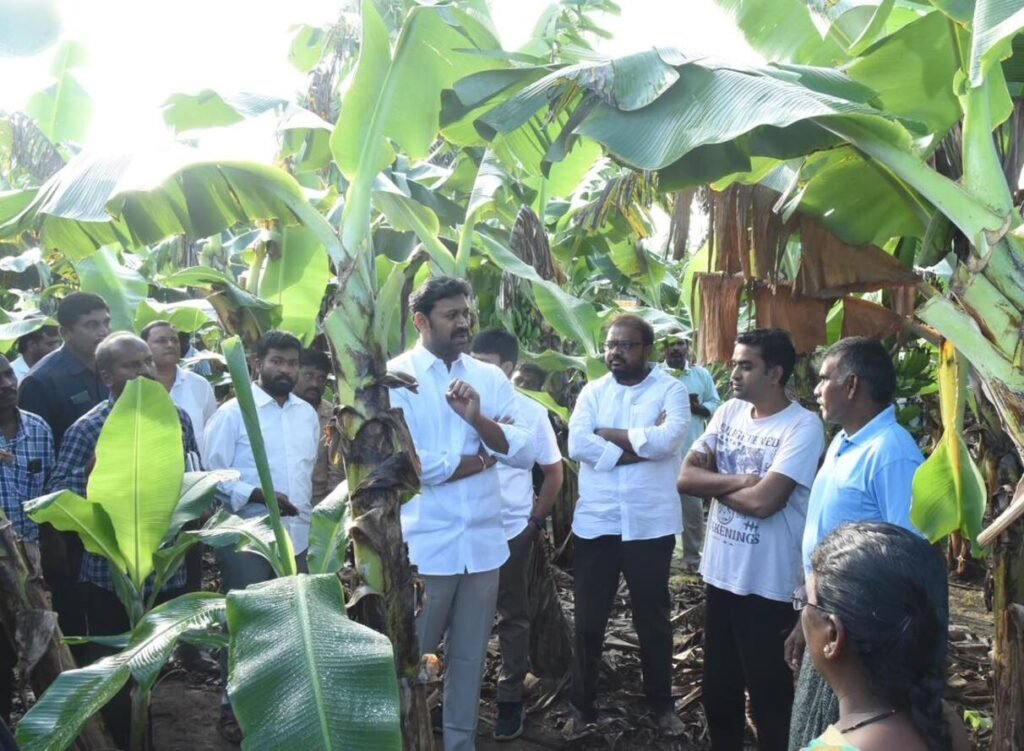
The agricultural economy of the Kadapa region has been pushed into severe distress following a dramatic collapse in banana prices, with farmers reporting market rates as low as ₹0.50 per kilogram. This unprecedented drop has placed thousands of farming families at risk, undermining months of labour, financial investment, and crop maintenance. The price crash has emerged as one of the most significant agricultural setbacks in recent years, intensifying demands for urgent government intervention to protect rural livelihoods.
Over the past few weeks, market volatility and distribution challenges have led to an oversupply scenario, leaving farmers with no viable market channels. The failure to ensure minimum price protection has resulted in bananas being sold at prices cheaper than matchboxes or single-unit biscuits. The collapse has sparked widespread concern about the sustainability of agricultural operations without state-supported safety mechanisms.
YS Avinash Reddy Engages Directly with Affected Farming Communities
In response to the growing crisis, Member of Parliament Sri YS Avinash Reddy visited banana-growing areas across the Kadapa belt to assess the scale of losses and interact directly with affected farmers. During the inspection, he observed that farmers who typically invest lakhs of rupees per acre on fertilizers, labour, irrigation, crop care, and transport are now unable to recover even a fraction of production costs. Many expressed concern over mounting debt, market failure, and the absence of institutional support.
Speaking to farmers and the media, YS Avinash Reddy stated that no agricultural sector can survive when prices fall below the cost of transport alone. He emphasized that ignoring the crisis would have long-term consequences for food security, employment, and rural economic stability. He assured farmers that he will strongly pursue intervention measures and liaise with government authorities to secure fair pricing mechanisms.
Agriculture Under Pressure: Causes Behind the Price Collapse
Agricultural experts highlight multiple contributing factors behind the current market breakdown, including unregulated supply chains, insufficient procurement channels, limited cold storage availability, and lack of organized export support. Farmers pointed out that post-harvest storage and transportation challenges leave them dependent on middlemen, who exploit the situation through low procurement bids.
The crisis has also reignited debate on whether the state should introduce Minimum Support Price (MSP) frameworks for fruits and perishable goods, similar to existing grain policies. Without structural reform, farming communities fear they will continue to face cycles of instability and debt.
Call for Strong Policy Action and Support Systems
During the field visit, YS Avinash Reddy stressed the need for immediate government steps to stabilize prices and protect farmers from distress sales. He highlighted the importance of creating permanent procurement mechanisms, expanding cold storage infrastructure, supporting export channels, and enabling transparent market access. The MP asserted that farmers must not be forced to destroy or abandon fully grown crops due to administrative inaction.
He further stated that the agricultural sector requires coordinated policies that balance production and market distribution. Intervention, he stressed, must reflect long-term sustainable solutions rather than temporary relief announcements.
Farmers Urge Urgent Relief and Structural Solutions
Farmers expressed gratitude for the MP’s direct engagement and requested timely action to prevent further losses. Many stressed that agriculture is not merely a profession but the backbone of the regional economy. Without financial stability and policy protection, they fear that youth may abandon farming, leading to a wider socio-economic decline.
Farmers also appealed for insurance settlement reforms, timely compensation, and organized support against climatic impacts and price manipulation. The crisis reflects the broader challenge of protecting agricultural communities in rapidly changing market conditions.
The Way Forward
The intervention of YS Avinash Reddy has amplified public focus on the issue, and local communities are hopeful that sustained pressure will lead to concrete policy action. Agriculture remains the foundation of livelihoods in Kadapa, and the current crisis has demonstrated the need for resilient systems, fair market practices, and institutional accountability.
As the situation evolves, stakeholders will closely observe government response, monitoring whether the crisis sparks real reform or becomes another case of temporary attention.