


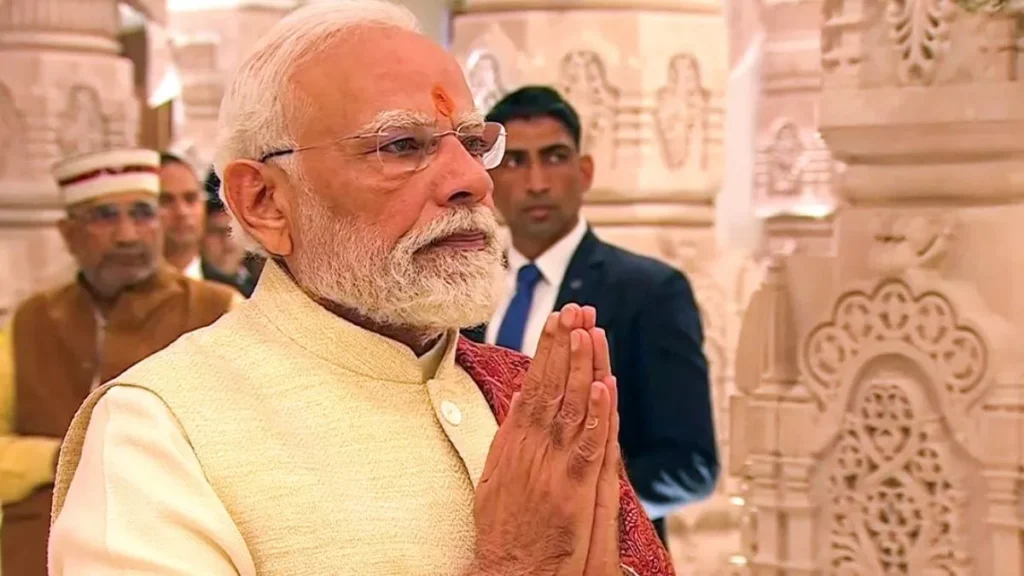
Prime Minister Narendra Modi is scheduled to attend a series of culturally and spiritually significant programs across Karnataka and Goa today, marking an important day that celebrates India’s heritage, devotion, and centuries-old temple traditions. The visit, which includes participation in a massive Bhagavad Gita recitation and the inauguration of landmark religious infrastructure projects, reflects the government’s ongoing emphasis on preserving and promoting Indic knowledge, spirituality, and cultural identity.
Laksha Kantha Gita Parayana in Udupi: A Historic Devotional Gathering
The Prime Minister began his day in Udupi, Karnataka, where he joined the Laksha Kantha Gita Parayana, a historic devotional event bringing together almost one lakh participants for the collective recitation of the Srimad Bhagavad Gita. The program, held at the revered Sri Krishna Matha, includes students, monks, scholars, community leaders, and devotees from across India. The mass chanting event symbolizes unity and spiritual discipline rooted in Advaita and Dvaita philosophical traditions.
During his visit, PM Modi also inaugurated the Suvarna Teertha Mantapa and dedicated the Kanaka Kavacha — a golden covering for the sacred Kanakana Kindi, associated with Saint Kanakadasa, who is believed to have seen Lord Krishna from this divine window. Sri Krishna Matha, where the event took place, was established more than 800 years ago by the philosopher-saint Madhvacharya, making it an enduring center of spiritual learning.
Visit to Goa for 550th Anniversary of Partagali Math
Following his Udupi program, the Prime Minister is scheduled to arrive at Partagali village in South Goa at 3:15 pm to participate in the 550th-year celebrations of Shree Samsthan Gokarn Partagali Jeevottam Math, an institution known for its deep historical and philosophical roots within the Gaud Saraswat Brahmin community and the broader spiritual landscape of the Konkan region. The event is expected to draw thousands of devotees, religious scholars, and community representatives.
A key highlight of the program is the unveiling of a 77-foot bronze statue of Lord Ram, which will stand as a symbolic monument dedicated to cultural reverence and national heritage. The Prime Minister will also inaugurate the newly developed Ramayana Theme Park, designed to educate and inspire future generations by bringing the epic’s narrative, values, and teachings into a public space through art and experiential design.
Cultural Significance and National Perspective
PM Modi’s participation in these ceremonies is being viewed as part of a larger national effort to revive and preserve ancient Indian cultural and spiritual institutions. The Ramayana Theme Park and monumental statue are expected to strengthen religious tourism and foster regional economic development. The mass Gita chanting in Udupi, meanwhile, emphasizes India’s growing engagement with traditional texts and collective faith practices.
In a statement prior to the visit, the Prime Minister said he felt honoured to be part of the historic Udupi programme, describing it as an occasion of profound spiritual unity.
Security and Administrative Arrangements
Large-scale security and logistical preparations are underway in both states, with multi-agency coordination to manage crowd movement, emergency services, and travel arrangements. Coastal police and district administrations have been deployed to ensure seamless conduct of events and public safety.
The Prime Minister’s spiritual tour connecting Udupi and Goa highlights a significant moment of cultural reflection and national pride, emphasizing devotion, heritage preservation, and community participation. With major religious infrastructure projects and mass public engagement, the visit reinforces India’s ongoing cultural renaissance.